

Sprint training guide · Speed endurance
Short speed endurance:
3 × 80m.
A speed endurance session for trained sprinters: how fast to run, how long to rest, and how to work out your target times, from two-time Olympian Simon Hansen.
Speed endurance is the ability to hold high speed as fatigue starts to build. The aim is fast, repeatable efforts with organised mechanics, not all-out time trials. This is session S1 from the HansenSprint Starter Pack, and it assumes you already have a sprint-training foundation.
| Session | Rest between repetitions |
|---|---|
| 3 × 80m | 8–10 min |
How fast?
Aim for about 95–98% of your current best average speed over 80m. Speed, not effort: to get the target time, divide your best 80m time by 0.98 and by 0.95. A 10.00 s best gives a target of about 10.20 to 10.53 s.
How to run it
Use a standing or three-point start, accelerate positively and keep your rhythm through the line. Keep conditions and the starting method the same if you want to compare times.
Coaching focus
Stay tall as fatigue builds and let your arms move freely. Avoid leaning back, straining or reaching to protect the time.
Start smaller if you need to
Begin with 2 × 80m (160m). If your speed drops despite full rest, end the session. Do not shorten the rest to make it harder.
Warm up first
Use your own structured warm-up or the HansenSprint Standard Preparation from the pack:
- 6–8 minutes of jogging or skipping, then 3 × 60m controlled strides at about 70%.
- Leg swings (side to side and front to back), hand-to-toe hamstring sweeps and 5–10 minutes of dynamic mobility and banded activation.
- Drills: walking high knees, A-skips, low dribbles, butt kicks with hip flexion, stiff-leg runs and high knees.
- 2–3 × 60m progressive build-ups (85% → 90% → 95%), plus 1–2 × 20m controlled accelerations if you need them to feel ready.
Why the long rest? Short sprints rely heavily on quickly available energy, including phosphocreatine. Rest restores that capacity and limits fatigue. Your breathing settles before your sprint readiness comes back, so wait until your legs feel responsive too.
Where it fits in your week
Place S1 later in an established sprint week, at least 48 hours after the previous hard sprint session. In the Starter Pack's three-day example for experienced sprinters, acceleration is on Monday, top speed on Thursday and speed endurance on Saturday. Only use three sprint days if you already tolerate them.
The pack's longer option, 2 × 150m with 12–15 minutes of rest, is for experienced athletes with recent exposure to longer fast runs.
Common mistakes
- Turning it into a time trial. 95–98% is fast, but it is not everything you have.
- Progressing volume instead of quality. Make the existing repetitions more consistent before you add more.
The 400m programs build specific endurance across a full season.
Get all seven sessions free
Three acceleration, two top-speed and two speed-endurance sessions, with both warm-ups, notes and tracking.
Keep reading
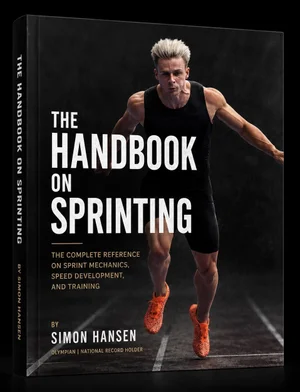
The Handbook on Sprinting
304 pages and 25 chapters by two-time Olympian Simon Hansen. Speed Maintenance and Deceleration (p. 45) and Energy Systems in Sprinting (p. 121) go deeper into everything on this page.