

Sprint training guide · Acceleration
A beginner acceleration
session you can run this week.
A short, repeatable acceleration session from two-time Olympian Simon Hansen. Ten and twenty metre starts, full rest, and a clear rule for when to stop.
Acceleration is the part of a sprint where you build speed: a forward push, short purposeful steps and a body that rises gradually as you get faster. For most athletes it is also where races and match situations are decided. This session, called A1 in the HansenSprint Starter Pack, is the entry point.
| Session | Rest between repetitions |
|---|---|
| 4 × 10m | 2 min |
| 4 × 20m | 3 min |
Complete all the 10m repetitions first, then take 3 minutes before the 20m repetitions. Start from a standing split stance.
How to run it
Intensity
Accelerate with high intent, but keep every start controlled and coordinated. If a start feels rushed or messy, it is not giving you what you want from the session.
Coaching focus
Push the ground away behind you and let your torso rise as speed builds. Make the first steps purposeful rather than reaching for a longer stride.
Start smaller if you need to
New or returning to sprinting? Begin with 3 × 10m and 3 × 20m (90m in total), and work through some controlled build-ups before you try maximal starts.
Warm up first
Use your own structured warm-up or the HansenSprint Standard Preparation from the pack:
- 6–8 minutes of jogging or skipping, then 3 × 60m controlled strides at about 70%.
- Leg swings (side to side and front to back), hand-to-toe hamstring sweeps and 5–10 minutes of dynamic mobility and banded activation.
- Drills: walking high knees, A-skips, low dribbles, butt kicks with hip flexion, stiff-leg runs and high knees.
- 2–3 × 60m progressive build-ups (85% → 90% → 95%), plus 1–2 × 20m controlled accelerations if you need them to feel ready.
When to stop. End the fast work if pain appears, if your coordination changes, or if you cannot reproduce the intended speed even after extra rest. Finish while your starts still look and feel repeatable, even if a repetition is left unused.
Where it fits in your week
Put A1 on your first sprint day after a rest day. A simple starting structure from the pack is A1 on Monday and, once you are comfortable building into fast upright running, the flying sprint session on Thursday, with rest or easy activity on the other days. A new athlete can start with one sprint day and add a second once recovery is reliable.
Leave at least 48 hours between demanding sprint days, often more. Heavy lifting, hard jumps, team training and matches all count towards that load.
Common mistakes
- Too much volume. Once quality drops, extra repetitions add fatigue without adding speed.
- Too little rest. The walk back is part of the recovery, not a replacement for it. Use the full rest period.
- Treating acceleration and top speed as the same thing. Acceleration is a forward push and a gradual rise; top speed uses upright mechanics and very short ground contacts. Train both, with different cues.
Want a full plan built around sessions like this? The Beginner programs run four days a week for 12 weeks.
Get all seven sessions free
Three acceleration, two top-speed and two speed-endurance sessions, with both warm-ups, notes and tracking.
Keep reading
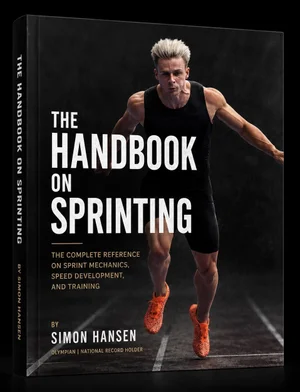
The Handbook on Sprinting
304 pages and 25 chapters by two-time Olympian Simon Hansen. Acceleration Mechanics (p. 29) goes deeper into everything on this page.