

Sprint training guide · Recovery
How much rest
between sprints?
Recovery times for acceleration, top speed and speed endurance work, and how to tell whether you are actually ready for the next repetition.
Rest is part of a sprint session, not a break from it. Cut it short and the session changes: you stop training speed and start training fatigue. These are the recovery guidelines from the HansenSprint Starter Pack.
| Work | Rest between repetitions |
|---|---|
| Acceleration, 10m | About 2–3 min |
| Acceleration, 20m | About 3–4 min |
| Acceleration, 30–40m | About 4–6 min |
| Flying 10m (top speed) | 4–5 min |
| Flying 20m (top speed) | 6–8 min |
| Speed endurance, 80m | 8–10 min |
| Speed endurance, 150m | 12–15 min |
Allow longer when the running is faster or the effort harder. For flying sprints, remember that the build-up costs energy too.
Why full recovery matters
Short sprints draw heavily on rapidly available energy, including phosphocreatine. Rest restores that capacity and limits the fatigue that builds up across a session. Your breathing settles before your sprint readiness returns, so a calm breath alone does not mean you are ready.
Use the clock and your readiness
- Walk back and stay lightly mobile.
- Wait until your breathing has settled and your legs feel responsive.
- If extra rest does not bring the quality back, finish the session.
- Keep hard drills, jumps and conditioning out of the rest periods.
A practical warning sign. With reliable timing, repeated slowing of roughly 3% suggests the quality has gone. It is not a universal threshold, so judge how the running looks and feels as well.
Rest between sessions
Avoid back-to-back demanding sprint days. Allow at least 48 hours between them, often 72 hours or more. Heavy lifting, hard jumps, team practice and competition all affect recovery, so replace existing hard work rather than adding sprint sessions on top.
The prescriptions are example coaching choices rather than a validated intervention. Background reading: Haugen et al. (2019), The Training and Development of Elite Sprint Performance, Sports Medicine – Open, 5:44.
Get all seven sessions free
Three acceleration, two top-speed and two speed-endurance sessions, with both warm-ups, notes and tracking.
Keep reading
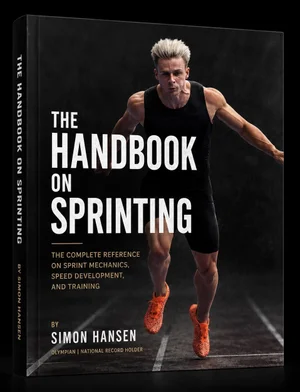
The Handbook on Sprinting
304 pages and 25 chapters by two-time Olympian Simon Hansen. Energy Systems in Sprinting (p. 121) and Recovery (p. 248) go deeper into everything on this page.