

Sprint training guide · Top speed
Flying sprints:
a top-speed session.
How to train maximum velocity with flying 10m sprints: the build-up, the fly zone, the rest and the cues, from two-time Olympian Simon Hansen.
Top speed sets the ceiling for every sprint. To train it, you need to actually run close to your maximum, and you need to be fresh enough to do it. Flying sprints solve that: you build up gradually and only run flat out through a short marked zone. This is session M1 from the HansenSprint Starter Pack.
| Session | Rest between repetitions |
|---|---|
| 4 × flying 10m | 4–5 min |
| 20–30m build-up before each | 20–30m gradual run-out after |
Mark three separate areas: the build-up, the 10m fly zone and the run-out. Experienced sprinters may need more than 30m to arrive close to top speed. Four repetitions add up to 120–160m of build-up and fly running, plus the run-outs.
How to run it
Intensity
Approach maximal speed in the fly zone while staying relaxed. Adding tension will not make you faster.
Coaching focus
Run tall through the hips with a relaxed face and shoulders. Put the foot down close beneath you instead of reaching forward to make your stride longer.
Start smaller if you need to
Begin with 3 repetitions. If you cannot enter the fly zone smoothly yet, use progressive runs first.
Timing
If you can time it, time only the 10m fly zone. That is the part that tells you about your top speed.
Warm up first
Use your own structured warm-up or the HansenSprint Standard Preparation from the pack:
- 6–8 minutes of jogging or skipping, then 3 × 60m controlled strides at about 70%.
- Leg swings (side to side and front to back), hand-to-toe hamstring sweeps and 5–10 minutes of dynamic mobility and banded activation.
- Drills: walking high knees, A-skips, low dribbles, butt kicks with hip flexion, stiff-leg runs and high knees.
- 2–3 × 60m progressive build-ups (85% → 90% → 95%), plus 1–2 × 20m controlled accelerations if you need them to feel ready.
When to stop. Finish the session if pain appears, your coordination changes or the speed will not come back after extra rest. With reliable timing, repeated slowing of roughly 3% is a practical warning sign, though not a universal rule. Judge the quality of the running as well as the clock.
Where it fits in your week
Run flying sprints on a dedicated speed day after an easy or rest day, and keep them separate from speed endurance work. In the Starter Pack examples, M1 sits on Thursday after an acceleration session on Monday. Once flying 10m runs are familiar, the pack's longer option is 3 × flying 20m with 6–8 minutes of rest.
Common mistakes
- Running speed sessions too slowly. Relaxed running should still be fast. Slower work has a place, but it trains something else.
- Short rest. The build-up costs energy too. Count it when you judge whether you are ready to go again.
- Combining everything. Blocks, flying sprints and long repetitions each carry a cost. Pick one main session for the day.
Footballers: top speed matters more than it looks, because a higher ceiling makes game-speed runs feel easier and more repeatable. See speed training for footballers.
Get all seven sessions free
Three acceleration, two top-speed and two speed-endurance sessions, with both warm-ups, notes and tracking.
Keep reading
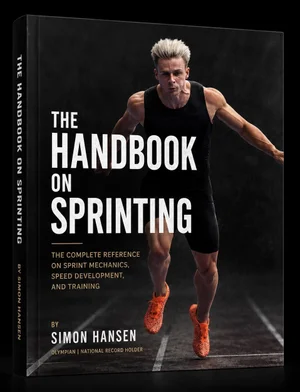
The Handbook on Sprinting
304 pages and 25 chapters by two-time Olympian Simon Hansen. Max Velocity Mechanics (p. 38) and Neural Freshness (p. 107) go deeper into everything on this page.